Price verified 2026-06 · Apartment management-office bill, Seoul, South Korea
Live in a Korean apartment and your electricity, water, security, cleaning, elevator — even parking — all land on one sheet of paper each month. June’s came to ₩306,790, so I went down the bill line by line to show what’s actually inside it.
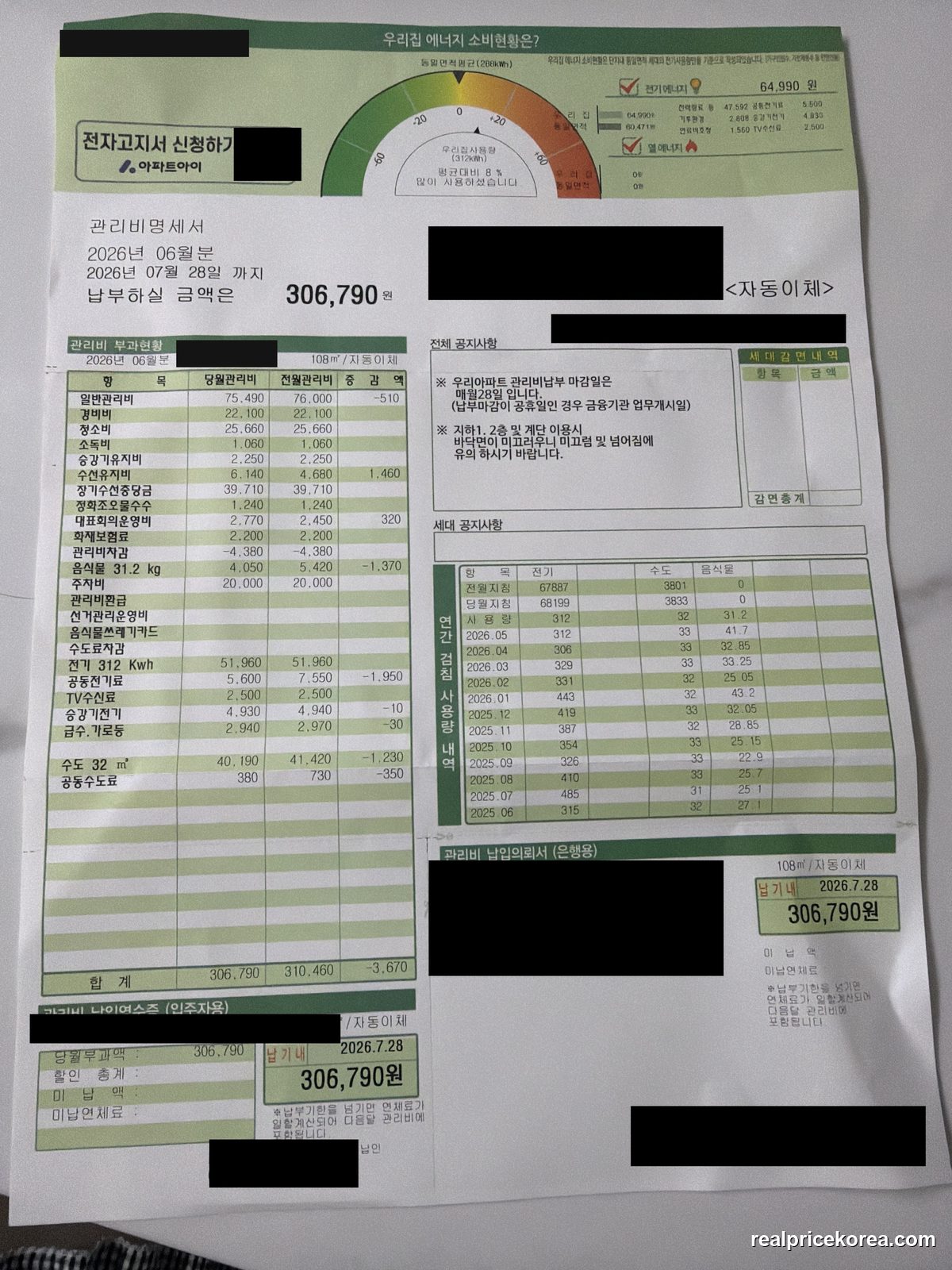
The June 2026 apartment maintenance fee (gwanribi) for our 108㎡ home in Seoul — two adults, two kids — came to ₩306,790. ()
What you get
This is our June 2026 maintenance bill — 관리비, gwanribi. It’s a 108㎡ apartment, about 33 pyeong, home to two adults and two kids in Seoul. Payment was due July 28, and the total came to ₩306,790. Last month was ₩310,460, so it dropped ₩3,670.
The part that trips people up coming from abroad: a Korean apartment doesn’t send you a separate electricity bill and a separate water bill. It’s all bundled onto this one sheet. Here’s exactly what was printed on it, line for line.
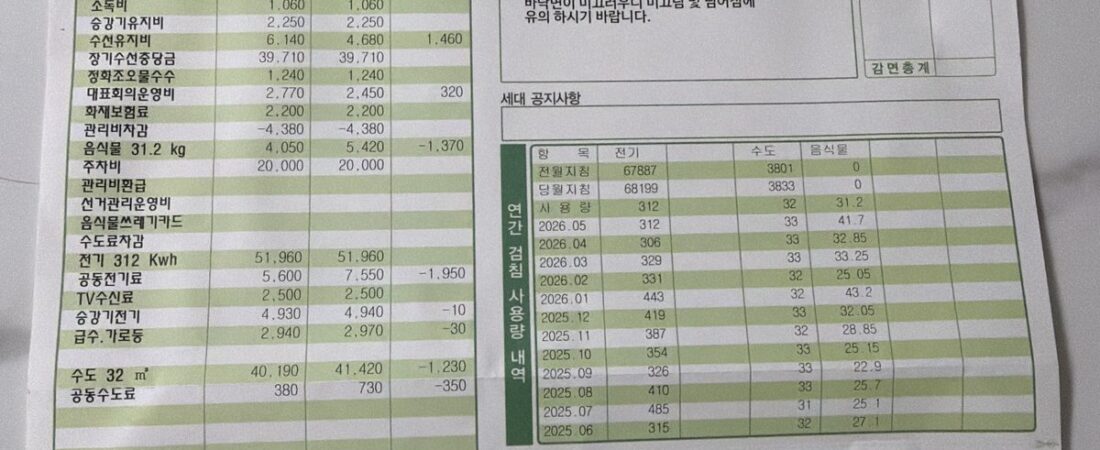
What we actually used, metered to our own unit: electricity 312kWh — ₩51,960; water 32㎥ — ₩40,190; food waste 31.2kg — ₩4,050.
Running the building, split across every household: general management ₩75,490 (the management office’s staff and day-to-day operations); security ₩22,100; cleaning ₩25,660; elevator maintenance ₩2,250 plus elevator electricity ₩4,930; disinfection ₩1,060; repairs ₩6,140; fire insurance ₩2,200; septic-tank/sewage fee ₩1,240; residents’ committee ₩2,770; shared electricity ₩5,600; shared water ₩380; water supply and street lights ₩2,940.
Everything else: parking ₩20,000; TV license ₩2,500; long-term repair reserve ₩39,710; and a maintenance credit of −₩4,380.
Two lines are worth explaining. The first is the long-term repair reserve — 장기수선충당금 — at ₩39,710. That isn’t money spent on this month’s service; it’s a fund the complex sets aside every month for the big jobs down the road, like replacing the elevator or fixing the exterior walls and plumbing. At about 13% of the total, it’s a hefty chunk. The second is the TV license fee at ₩2,500 — in Korea the KBS broadcast fee rides along with electricity, so it gets collected right here on the maintenance bill.
At the very top, the bill compares our electricity use against the average for units our size. This month the average was 288kWh; we used 312kWh, so it prints, in so many words, that we used 8% more than average. You see that every month, and it does quietly get under your skin.
It swings hard by season, too. Down the right side, the bill prints a full year of meter readings. Last July was the highest at 485kWh — air conditioning — and this past January was 443kWh. Water, by contrast, barely moves: 31 to 33㎥ every month of the year. And this June’s line for heat energy is ₩0 — no heating that month, so it’s left blank. On winter bills, heating shows up right there.
Maintenance fees differ from one complex to the next, and by the number of households in the building. In ours, payment is due on the 28th of each month.
Price details
| Item | Apartment maintenance fee (관리비, gwanribi) — June 2026 bill, 108㎡ home, 2 adults + 2 kids |
| Price | ₩306,790 — |
| Where | Apartment management-office bill, Seoul, South Korea |
| Date | June 2026 |
Tip: This bill is paid by auto-transfer (자동이체), and you can switch it to paperless e-billing (전자고지서). The payment deadline is the 28th of each month.
FAQ
How much is the apartment maintenance fee (gwanribi) in Korea?
For our 108㎡ apartment in Seoul, home to two adults and two kids, the June 2026 maintenance bill was ₩306,790, down ₩3,670 from ₩310,460 the month before. It varies by complex, unit size and number of households.
What’s included in a Korean apartment maintenance fee?
It’s all bundled onto one sheet: your own electricity (312kWh, ₩51,960) and water (32㎥, ₩40,190), plus building-wide costs split across households — general management ₩75,490, security ₩22,100, cleaning ₩25,660, elevator, disinfection, fire insurance, parking ₩20,000, and a long-term repair reserve.
What is 장기수선충당금 (the long-term repair reserve)?
It’s a monthly amount the complex sets aside for future major repairs — replacing elevators, or fixing exterior walls and plumbing. On this bill it was ₩39,710, about 13% of the total, and it isn’t spent on the current month’s service.
Why is there a TV license fee on the maintenance bill?
In Korea the KBS broadcast license fee (₩2,500 here) is collected together with electricity, so it appears on the apartment maintenance bill rather than as a separate charge.
This price is as of 2026-06 (date of writing) and may vary by store.